


Quick Answer: Your First Steps
After bonding out on a first DUI arrest, take these steps as soon as possible:
- Read every document you received at jail, from law enforcement, and from the bond process.
- Follow every written condition of release and do not miss your court date.
- Do not drive unless your current Florida license status and any temporary permit clearly allow it.
- Treat the first 10 days after arrest as urgent because Florida allows a request for a formal or informal review of an administrative suspension within that window.
- Speak promptly with a qualified Florida DUI defense attorney about the criminal charge and the driver-license suspension.
- Keep your bail bondsman informed if your contact information, address, employment, or court status changes.
- Plan safe transportation before the temporary permit expires or while you wait to learn whether you qualify for restricted driving privileges.
This is general information, not legal advice. A DUI arrest can involve facts that change the correct next step, including your age, prior driving record, test results, whether you refused testing, commercial-license status, injuries, property damage, and the exact paperwork issued at arrest.
Bonding out of jail after a first DUI arrest is only the beginning. Your immediate priorities are to follow every bond condition, keep track of your court date, and address your Florida driver-license situation right away, because the DMV process can begin before your first court appearance.
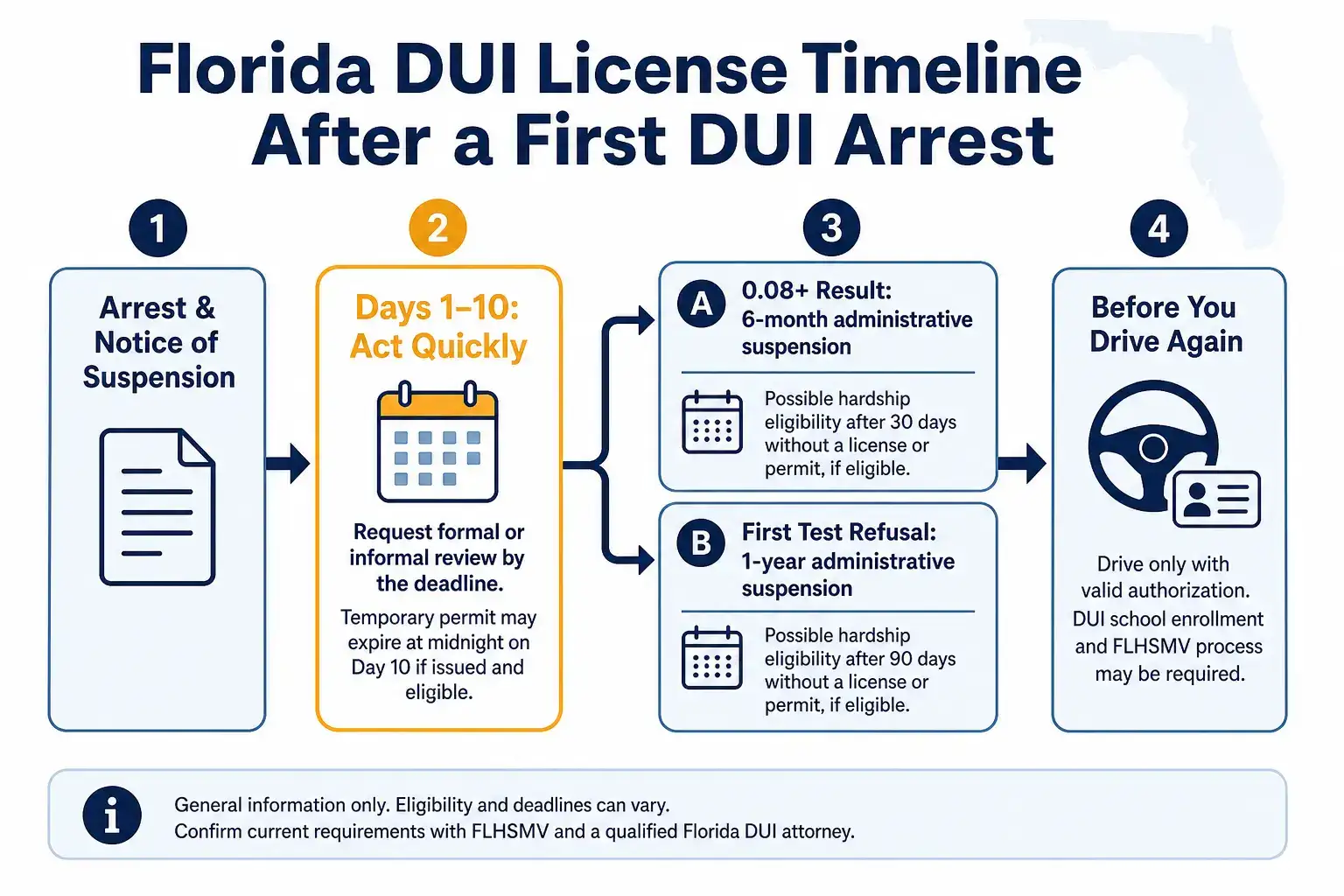
If you were released after a DUI arrest in Lake County, do not assume that release on bond means you can drive normally. Florida may impose an immediate administrative driver-license suspension after an alleged breath or blood alcohol level of 0.08 or higher or after a refusal to submit to a lawful test. The temporary permit issued at arrest, if you receive one and are otherwise eligible, generally expires at midnight on the 10th day after the suspension notice.
Start With Your Bond Conditions
Your bond is a promise that you will comply with the court process. Before you focus on the DMV, make sure you understand the terms of your release.
Read your bond paperwork, release documents, and any paperwork that identifies your charges, court date, or special conditions. Conditions can vary by case. They may involve appearing in court, avoiding new arrests, maintaining contact information, avoiding alcohol or controlled substances, or complying with other restrictions ordered in your case.
Keep Your Court Date in Sight
Do not rely on memory, a verbal estimate, or a family member’s notes. Put the date, time, courtroom information, and case number into your phone and calendar as soon as you have them.
Lake County court records can be accessed through the Lake County Clerk’s online court-records system after records are reviewed and made publicly available. The Clerk advises that many records from 2003 to the present can be viewed electronically, though availability can vary.
If you are unsure about a court date, contact your attorney or verify the information through an appropriate official court source. Missing court can create serious problems, including a possible warrant and complications with your bond.
Stay in Contact With Your Bondsman
If you used a surety bond, do not disappear after release. Keep your phone number and address current, answer reasonable communications, and immediately report a court-date change or another issue that affects your ability to appear.
Bail Bondsman Tim Altman can help answer questions about the bond process and your bond obligations. A bail bondsman does not replace a criminal-defense attorney and cannot give legal advice about how to defend a DUI charge or which DMV option you should choose.
Do Not Assume You Can Drive
A DUI bond gets a person released from custody. It does not automatically restore driving privileges.
Florida treats the criminal DUI case and the driver-license suspension as separate processes. The criminal case will move through the court system. The license issue may move immediately through the Florida Department of Highway Safety and Motor Vehicles, commonly called FLHSMV or the DMV.
Under Florida Statutes § 322.2615, a law-enforcement or correctional officer acting for the department suspends the driving privilege of a person who had an unlawful blood or breath alcohol level of 0.08 or higher, or who refused to submit to a requested breath, blood, or urine test. The officer takes the driver license, issues a notice of suspension, and may issue a 10-day temporary permit if the driver is otherwise eligible.
Read the Notice of Suspension
The paperwork you receive after arrest may serve more than one purpose. It may identify the alleged basis for suspension, provide information about the temporary permit, and explain review rights and deadlines.
Keep the original documents in a safe place. Take clear photos or scans for your records. A DUI attorney will usually need to review the notice, citation, breath-test documents if applicable, and other arrest paperwork quickly.
The temporary permit is time-limited. Florida law states that the temporary permit issued at the time of suspension expires at midnight of the 10th day following the suspension notice.
The 10-Day Florida DMV Deadline
For many first-time DUI arrests, the most time-sensitive issue is the administrative review deadline.
Florida law states that a driver may request a formal or informal review of the suspension within 10 days after the date the notice of suspension was issued. The statute also refers to requesting a review of eligibility for a restricted driving privilege under Florida law.

Why the Deadline Matters
The administrative suspension is not automatically decided by what eventually happens in criminal court. FLHSMV explains that its administrative review process may sustain, amend, or invalidate an administrative suspension, and that the disposition of the related criminal proceeding does not affect a suspension or disqualification in the same way.
A person facing this decision should not casually choose a formal review, informal review, waiver, or no response without understanding the consequences. The best step is to contact a qualified Florida DUI defense attorney promptly, ideally while the 10-day period is still open.
Formal and Informal Review
Florida law provides two review paths:
- An informal review is based on the materials submitted by law enforcement and the driver. Officer or witness attendance is not required.
- A formal review is a hearing where the designated hearing officer may receive evidence, examine witnesses, issue subpoenas, and make a ruling on whether the suspension should be sustained, amended, or invalidated.
This article cannot tell you which option is better for your case. That choice can depend on the arrest facts, paperwork, prior history, evidence, and your driving needs.
First DUI: 0.08 or Higher vs. First Refusal
For a first-time DUI arrest, the license consequences can differ depending on whether the suspension is based on an alleged alcohol level of 0.08 or higher or a first refusal to submit to a requested test.
| Suspension basis | Administrative suspension period | Temporary permit | Restricted-license waiting period if sustained |
|---|---|---|---|
| Alleged blood or breath alcohol level of 0.08 or higher | 6 months (first offense) | Up to 10 days if otherwise eligible | 30 days after last temporary permit expires |
| First refusal to submit to breath, blood, or urine testing | 1 year | Up to 10 days if otherwise eligible | 90 days after last temporary permit expires |
Florida Statutes § 322.2615 identifies a six-month suspension for a first alleged 0.08-or-higher blood or breath alcohol level and a one-year suspension for a first refusal. It also identifies the 30-day and 90-day waiting periods for a business-or-employment restricted license after a sustained suspension.
FLHSMV’s DUI administrative-suspension guidance states the same general timing: a person suspended based on an unlawful alcohol level must serve 30 days without a license or permit before hardship eligibility, while a first-refusal suspension requires 90 days without a license or permit before eligibility.
If You Blew 0.08 or Higher
A first alleged breath or blood alcohol level of 0.08 or higher can result in an immediate administrative suspension separate from the DUI criminal charge. Florida’s published guidance states that the first administrative suspension for a person over 21 with an alcohol level of 0.08 or above is six months.
If the suspension is sustained, Florida law states that a person is not eligible for a business-or-employment license until 30 days have passed after expiration of the last temporary permit. If no 10-day permit was issued because the person was ineligible, the 30-day period runs from the date of suspension.
That does not mean every driver automatically qualifies after 30 days. Eligibility still depends on the applicable laws, the driver’s record, FLHSMV requirements, and the outcome of the administrative process.
If You Refused a Test
A first refusal case requires extra attention because the administrative suspension is generally longer and the hardship-license waiting period is longer.
Florida law states that a first refusal to submit to a lawful breath, blood, or urine test results in a one-year suspension. FLHSMV likewise states that a first refusal brings a one-year suspension and that the suspension is effective immediately.
If the refusal suspension is sustained, the driver is generally not eligible for a business-or-employment license until 90 days have passed after the last temporary permit expires. If no temporary permit was issued because the person was not eligible, the 90-day period runs from the suspension date.
A refusal-related administrative suspension is not erased simply because the related DUI criminal case later has a different outcome. Florida law specifically says that the disposition of related criminal proceedings does not affect a suspension for refusal to submit to blood, breath, or urine testing.
What Is a Florida Hardship License?
A hardship license is commonly described as a limited business or employment purposes only driving privilege. It is not the same as getting your unrestricted Florida driver license back.
A hardship license can be vital for someone who needs to drive to work, school, medical care, DUI school, treatment, or another approved purpose. But it is limited, and the actual authorization matters. Do not assume that a hardship credential lets you drive anywhere, at any hour, or for social reasons.
FLHSMV states that a person suspended for an unlawful alcohol level or a refusal must show proof of DUI-school enrollment and apply for an administrative hearing for possible hardship reinstatement.
What “Possible” Means
The word “possible” matters. Hardship reinstatement is not automatic. An applicant may need to meet eligibility requirements, complete required steps, pay applicable fees, and receive approval through the appropriate FLHSMV process.
Your own history can change the answer. Prior DUI-related suspensions, multiple refusals, an existing suspension for another reason, a commercial license, court orders, or other licensing issues may affect eligibility.
Florida says there is no hardship reinstatement for two or more refusals through this administrative-suspension pathway. This article focuses on first-time arrests and first refusals, but even a first arrest should be reviewed individually before a person acts.
How to Prepare for a Hardship License
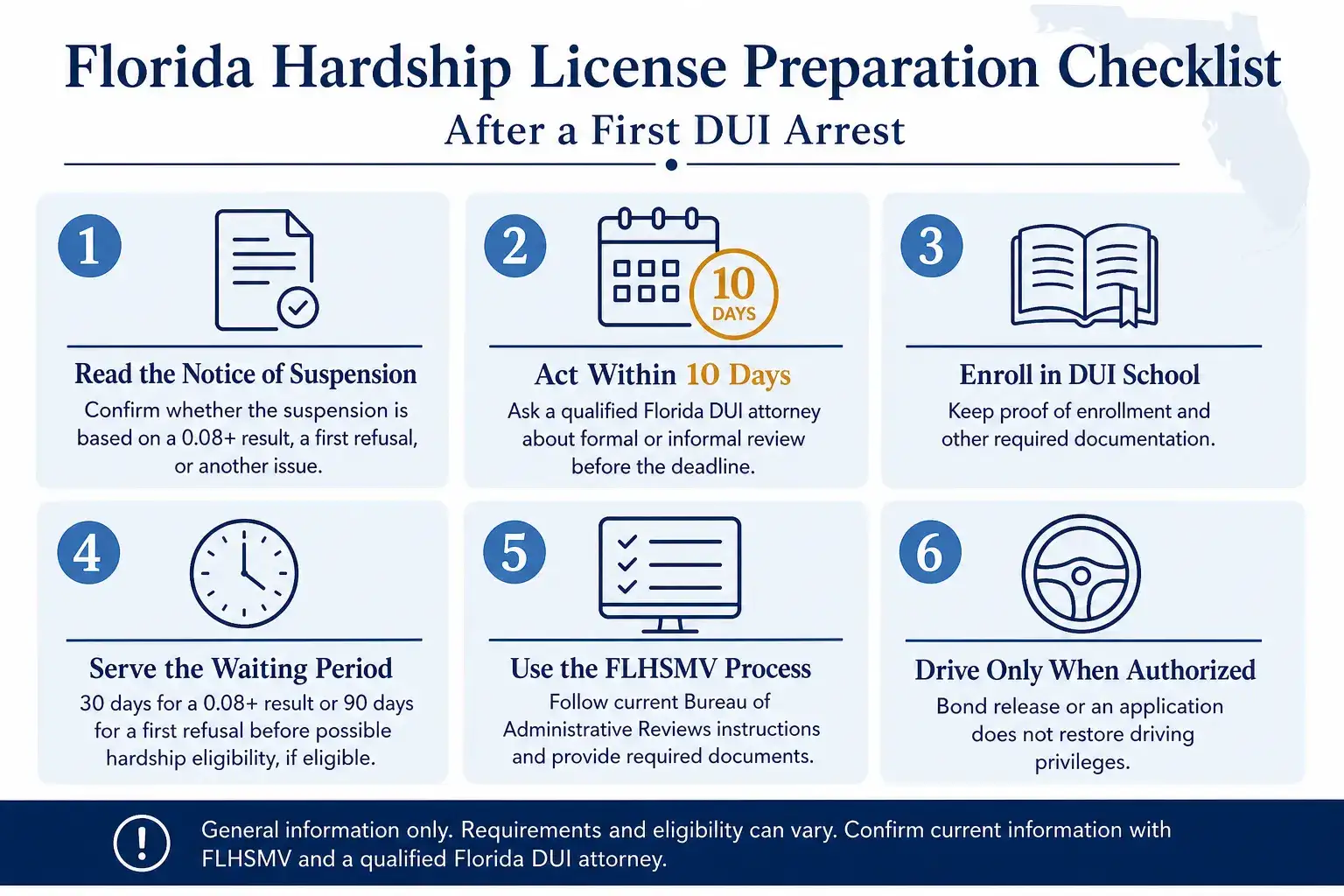
If you are considering a hardship license after a first DUI arrest, use this checklist to organize your next steps.
1. Confirm Why Your License Was Suspended
Review the notice of suspension and related documents. Determine whether FLHSMV is treating the suspension as:
- An alleged alcohol level of 0.08 or higher
- A first refusal to submit to breath, blood, or urine testing
- A different issue, such as a separate suspension or commercial-driver disqualification
The basis matters because it changes the suspension duration and the possible hardship timing.
2. Do Not Miss the Review Window
Florida allows a request for formal or informal review within 10 days after the notice of suspension.
Do not wait for your arraignment to ask about this. A DUI attorney can help you understand the administrative review process, identify deadlines, and determine what documents should be preserved.
3. Follow DUI-School Requirements
For administrative suspensions involving an unlawful alcohol level or refusal, FLHSMV says the driver must show proof of enrollment in DUI school and apply for an administrative hearing for possible hardship reinstatement.
Keep copies of enrollment receipts, completion documents, assessments, and any related correspondence. If the state requests documentation, you do not want to be searching for it at the last minute.
4. Serve the Applicable No-Driving Period
For a first suspension tied to an alleged 0.08-or-higher result, FLHSMV states that the person must serve 30 days without a driver license or permit before hardship eligibility. For a first refusal, the stated waiting period is 90 days without a license or permit.
The statute describes this timing in relation to the end of the last temporary permit or, if no permit was issued due to ineligibility, the date of suspension.
5. Apply Through the Appropriate FLHSMV Process
Hardship-license applications and administrative hearings are handled through FLHSMV and its Bureau of Administrative Reviews process. Florida’s DUI guidance says a driver may need to apply for a hearing and provide DUI-school enrollment proof for possible hardship reinstatement.
FLHSMV’s DUI FAQ also states that a person applying for a hardship license before the end of a revocation period may need proof of completion from a DUI program and treatment provider if referred by the court, along with required exams and fees at reinstatement. Those requirements are particularly important after a conviction, so do not confuse a post-conviction reinstatement process with the administrative-suspension process after arrest.
6. Do Not Drive Until You Are Actually Authorized
Never treat an application receipt, DUI-school enrollment, attorney consultation, or bond release as permission to drive. Drive only if you have a valid temporary permit, restricted credential, or reinstated license that clearly authorizes you to drive.
Driving while your privilege is suspended can create additional legal and licensing problems. Arrange rides, use public transportation where available, ask family for help, use rideshare services, or make other legal transportation arrangements while your eligibility is being determined.
Important Note for Commercial Drivers
Commercial drivers face additional concerns. FLHSMV states that a person disqualified from operating a commercial motor vehicle cannot obtain a hardship license to operate a CMV. A temporary permit issued after an alcohol-related CMV disqualification does not authorize commercial driving.
If you hold a CDL or drive commercially for work, speak with a qualified attorney immediately. Your personal driving privilege, CDL privilege, employment, and federal or state rules may all be involved.
Criminal Court and DMV Are Separate
The court case matters, but it does not replace the DMV process.
A first DUI conviction can result in a separate driver-license revocation. FLHSMV states that a first DUI conviction without bodily injury carries a revocation of at least 180 days and up to one year. That is different from the immediate administrative suspension that can begin after arrest.
The same distinction is important for hardship licenses. A person seeking hardship reinstatement after a conviction may face requirements that differ from the administrative-suspension path, including DUI school, possible treatment requirements, fees, testing, and ignition-interlock requirements in certain situations.
This is why a person should not assume that resolving the criminal case will automatically resolve the license issue, or vice versa.
What Your Bail Bondsman Can Help With
After bonding out, a bail bondsman can help explain your bond paperwork, the general release process, and the importance of appearing in court. If you have a bond-related question, contact the Main Office rather than guessing.
For Lake County families, Altman Bail Bonds can handle much of the bond process remotely by phone, including paperwork and payment for qualifying clients. The business posts bonds for release at the Lake County Detention Center in Tavares and the Clermont South Lake substation.
Your attorney is the person to contact for legal advice about the DUI charge, DMV hearing decisions, test refusal issues, evidence, and the best approach for your individual case.
First DUI Bonding Out
Frequently asked Questions
Can I drive after bonding out on a first DUI in Florida?
Not automatically. Posting bond gets you released from custody, but it does not automatically restore your driver license. Review the notice of suspension and temporary-permit paperwork, and do not drive after the permit expires unless you have a valid authorization to do so.
How long do I have to deal with the DMV after a DUI arrest?
Florida law allows a request for a formal or informal administrative review within 10 days after the notice of suspension is issued. The temporary permit generally expires at midnight on the 10th day after the notice.
What happens to my license if I blew 0.08 on a first DUI?
For a first administrative suspension based on an alleged blood or breath alcohol level of 0.08 or higher, Florida law lists a six-month suspension. If the suspension is sustained, business-or-employment license eligibility generally begins only after the applicable 30-day waiting period.
What happens if I refused a breath test on a first DUI?
A first refusal can result in a one-year administrative suspension. If sustained, Florida law generally requires a 90-day waiting period after the last temporary permit expires before eligibility for a business-or-employment license.
Can I get a hardship license after a first DUI refusal?
Possibly, but it is not automatic. FLHSMV states that a first-refusal suspension requires 90 days without a driver license or permit before hardship eligibility, and it identifies DUI-school enrollment and an administrative-hearing application as part of the possible hardship-reinstatement process.
Do I need DUI school for a hardship license after arrest?
FLHSMV states that a person suspended for an unlawful alcohol level or refusal must show proof of DUI-school enrollment and apply for an administrative hearing for possible hardship reinstatement. Requirements can change based on the case and licensing history, so confirm the current process before acting.
Does a DUI case dismissal automatically fix a refusal suspension?
Not necessarily. Florida law states that the disposition of a related criminal proceeding does not affect a suspension for refusal to submit to a breath, blood, or urine test.
Can a CDL holder obtain a hardship license to drive a commercial vehicle?
No. FLHSMV states that a person disqualified from operating a commercial motor vehicle cannot obtain a hardship license to operate a CMV.
Need Help With a Lake County DUI Bond?
If you or a family member needs help understanding a Lake County bail bond after a DUI arrest, contact Bail Bondsman Tim Altman. We can help explain the bond process, release paperwork, and the importance of staying on top of court obligations.
Altman Bail Bonds, Inc. is located at 801 W Main St, Tavares, FL 32778, near the Lake County Detention Center. The Main Office answers bond calls 24/7.